Yes - and the useful version of that answer includes the number that does not improve, and the people it does not help.
Anyone selling you something will give you the first half. Here is all of it.
What the guidelines say, and how strongly
Two things are worth separating: whether a body recommends something, and how hard.
The American Academy of Sleep Medicine's behavioral guideline makes exactly one strong recommendation for chronic insomnia in adults: use multicomponent CBT-I. Everything else in that document - brief versions, stimulus control alone, sleep restriction alone, relaxation alone - is conditional. And sleep hygiene as a standalone treatment gets a recommendation against.
The American College of Physicians reached the same place in 2016: all adults with chronic insomnia should receive CBT-I as the initial treatment. Strong recommendation, moderate-quality evidence. The European guideline, updated in 2023, calls it first-line for adults of any age including those with other conditions, delivered in person or digitally.
For contrast, the AASM's separate guideline on insomnia medications makes fourteen drug recommendations. All fourteen are weak, on low or very low quality evidence, and the document states that all patients with chronic insomnia should receive CBT-I as the primary intervention.
That asymmetry is the single most useful fact in this article.
The actual numbers
The most-cited pooled analysis brought together twenty randomized trials, 1,162 people. Immediately after treatment:
- Falling asleep: about 19 minutes faster (95% CI 14.1 to 23.9)
- Time awake during the night: about 26 minutes less (95% CI 15.5 to 36.5)
- Sleep efficiency - the share of time in bed actually asleep: up about 10 percentage points (95% CI 8.1 to 11.7)
Those are averages across many people. They describe what the method does, not what your particular six weeks will do.
The number that does not move
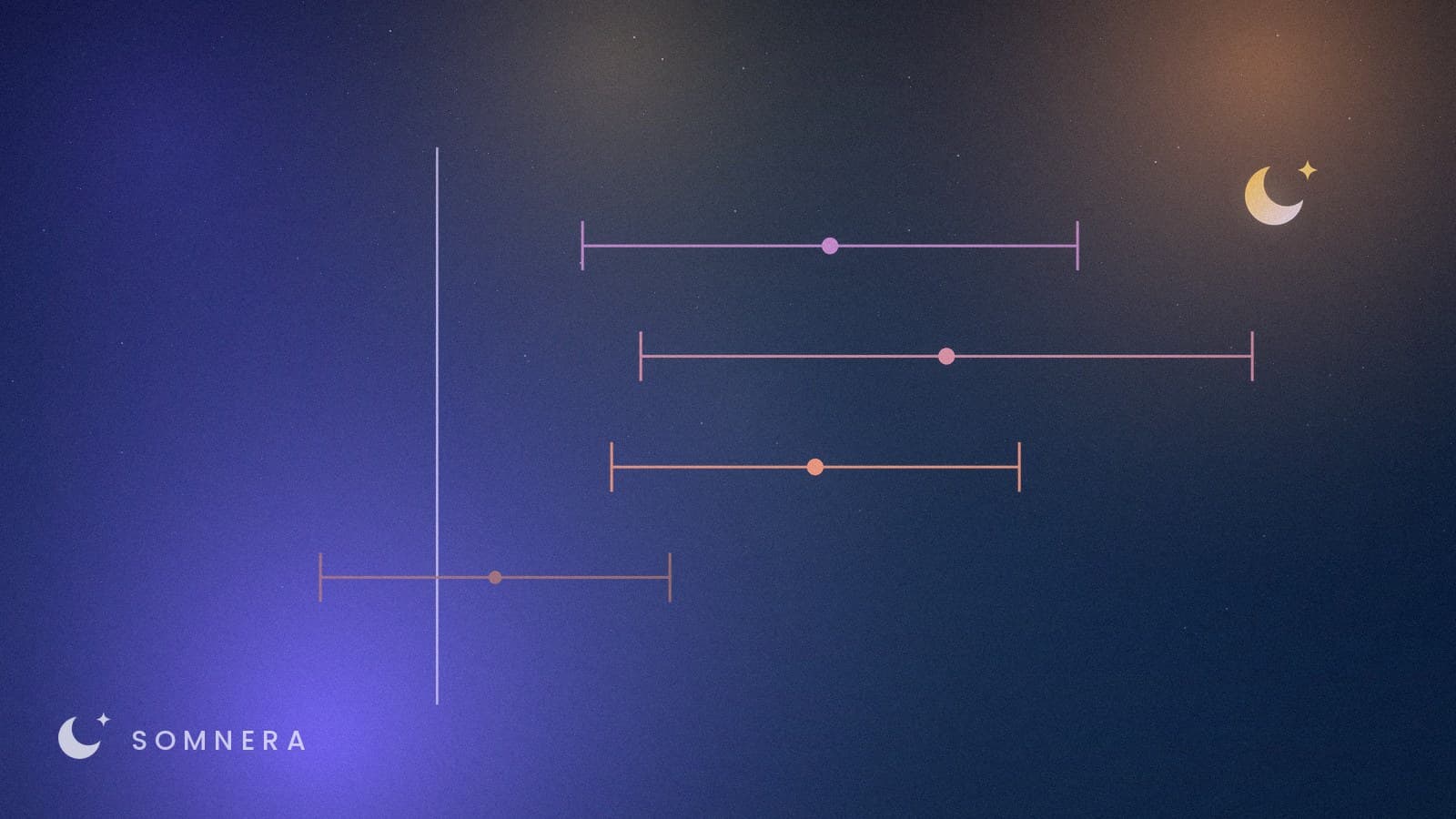
Total sleep time improved by about eight minutes, and the confidence interval crossed zero - meaning the result was not statistically significant, at any follow-up point the authors examined.
This is worth sitting with, because it sounds like a failure and is not.
Six hours slept in one block is a completely different night from six hours scattered across nine hours in bed with three long wakings. Same total. Nothing like the same experience, and nothing like the same next day. What CBT-I reliably changes is the consolidation, and consolidation is most of what people mean when they say they slept well.
Any program that promises you more hours is promising something the evidence does not support. That includes ours.
Compared with medication, head to head
The comparison people actually want is against a sleeping pill, measured properly.
One double-blind, placebo-controlled trial did it with polysomnography in older adults with chronic insomnia: CBT versus zopiclone versus placebo. At six weeks, measured sleep efficiency rose from 81.4% to 88.9% in the CBT group, while the zopiclone group went from 82.3% to 81.5% - and the placebo group got worse. Total wake time fell 52% with CBT against 4% with the drug. At six months the CBT group was at 90.1% and the medication group at 81.9%.