Somnera
CBT-I science

How long does CBT-I take to work?

Four to eight weeks in the trials, worse before better, and a specific week where most people quit. What the timeline actually looks like.

5 min read

Last reviewed September 1, 2026

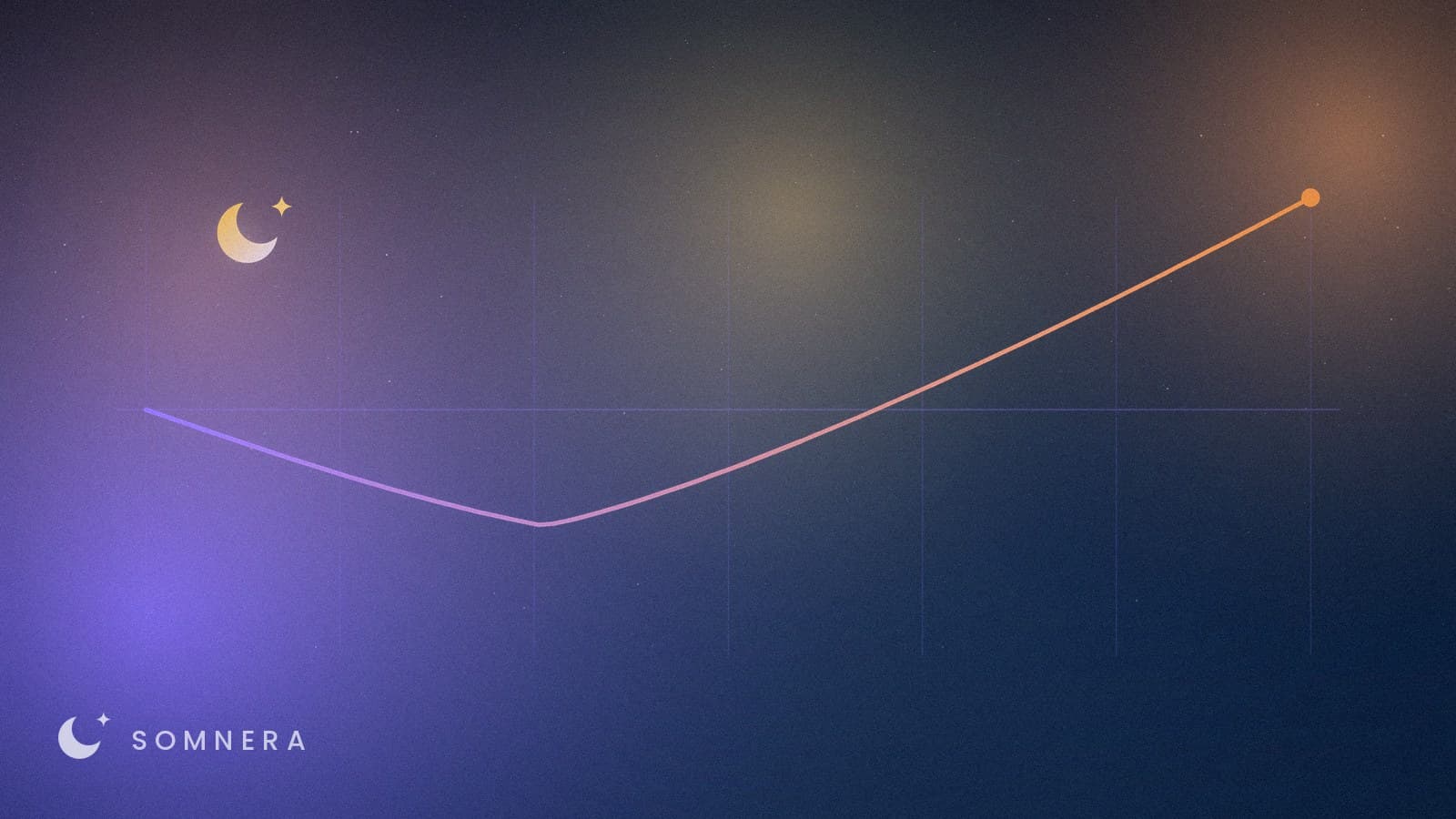
A line dipping below its baseline before climbing well above it, across evenly spaced weeks.

Share

Four to eight weeks in the research, with the change usually appearing somewhere in weeks two to four — after a stretch of feeling worse rather than better.

That last clause is the part that gets left out of most descriptions, and it is the reason a lot of people conclude CBT-I does not work when what actually happened is that they stopped during the phase where it is supposed to feel bad.

The honest timeline

Week one: nothing happens, on purpose

The first week is baseline. You keep a diary and change almost nothing, because the sleep window is calculated from your own numbers and those numbers do not exist yet.

People find this week frustrating. It is also non-negotiable: a window set from a guess is either far too aggressive, which is unpleasant and unsafe, or barely restrictive, in which case nothing shifts.

Week two: the hard one

The window comes in and your time in bed drops to roughly what you have actually been sleeping. Sleep pressure starts building, and in the meantime you are more tired during the day, not less.

This is measured, not anecdotal. Kyle and colleagues found reduced total sleep time, increased daytime sleepiness and objectively impaired vigilance during the restriction phase. It is the mechanism working.

It is also, unsurprisingly, where most people quit — roughly at the point where the approach is doing the thing it does.

Weeks three and four: the first real signal

What usually moves first is not total hours. It is consolidation: falling asleep faster, and less time awake in the middle of the night.

The pooled figures across randomized trials of CBT-I are about 19 minutes faster to fall asleep and about 26 minutes less time awake during the night, with sleep efficiency improving by roughly 10 percentage points. Those describe the method across many people, not a forecast for your particular fortnight.

Notably, total sleep time is the number that moves least — in that same analysis it was not statistically significant. People often sleep a similar amount and experience it completely differently, because six hours slept in one block is not the same night as six hours scattered across nine.

Weeks five and six: widening

As efficiency holds high, the window opens back up in small increments. This is where total sleep tends to increase, and where the gains have to be defended against the urge to widen faster than the data supports.

After: the part that matters most

The strongest argument for CBT-I is not that it is quick. It is that improvements are generally maintained after treatment ends. Nothing is being propped up — you have changed a schedule and a set of associations, and those persist.

Take the free assessment to see:

  • Your Insomnia Severity Index (ISI) score
  • A personalized 6-week CBT-I plan, built by a sleep physician
  • How your sleep improves, night by night
Start free assessment

That is the comparison clinical guidelines are making when they put it ahead of medication. The American College of Physicians has recommended it as the first-line approach for chronic insomnia in adults since 2016, and the AASM's behavioral guideline reached the same conclusion.


Why yours might be slower

Three things account for most of it, and two are fixable.

The rising time has slipped. This is by far the most common. A weekend lie-in shifts the whole schedule and takes days to unwind, which is why Monday nights are so reliably bad. If the wake time has not genuinely held every day, the protocol has not really been run.

The window was widened early. Three good nights arrive, going to bed half an hour earlier feels like a reasonable reward, and it dilutes the pressure that produced the good nights.

Something else is going on. Insomnia alongside significant depression, anxiety, pain, or an untreated sleep disorder responds more slowly, and sometimes the other thing needs addressing first.

What to do if week four arrives and nothing has moved

Check the two fixable causes above, honestly. Most stalled programs are one of them.

If the rising time has held and the window has not been widened early, give it through week six — the trials run to eight weeks for a reason and plenty of people are late responders.

If nothing has shifted by then, that is genuinely worth taking to a clinician rather than running the protocol harder. Bringing two weeks of diary to that appointment makes it a much better conversation, and it is exactly the sort of case where working with someone in person earns its cost.

The expectation to set

Not "better in a week." Something closer to: two weeks of it feeling worse, a first signal somewhere in weeks three and four, and consolidation before quantity.

People who are told that in advance finish. People who expect improvement by day five stop on day six, and conclude the approach failed when what failed was the forecast.

The rest of this section covers what the six weeks contain and how the routes compare.

Somnera is a self-guided education program built on CBT-I, founded and written by Dr. Camilo Ruiz, DO, FACOI, FAASM. It is not a diagnosis and does not replace care from your own clinician. The assessment is free and gives you a baseline to measure against.

Citations

  • Trauer JM, et al. Cognitive behavioral therapy for chronic insomnia: a systematic review and meta-analysis. Ann Intern Med. 2015;163(3):191–204. doi:10.7326/M14-2841
  • Kyle SD, et al. Sleep restriction therapy for insomnia is associated with reduced objective total sleep time, increased daytime somnolence, and objectively impaired vigilance. Sleep. 2014;37(2):229–237. doi:10.5665/sleep.3386
  • Qaseem A, et al. Management of chronic insomnia disorder in adults: a clinical practice guideline from the American College of Physicians. Ann Intern Med. 2016;165(2):125–133. doi:10.7326/M15-2175
  • Edinger JD, et al. Behavioral and psychological treatments for chronic insomnia disorder in adults: an American Academy of Sleep Medicine clinical practice guideline. J Clin Sleep Med. 2021;17(2):255–262. doi:10.5664/jcsm.8986

Frequently asked questions

Trials generally run the full approach over four to eight weeks. Change tends to appear somewhere in weeks two to four, after an initial stretch of feeling more tired rather than less.

Restricting time in bed increases daytime sleepiness before it consolidates sleep. That is the mechanism doing its work, and it has been measured directly. It is also where most people stop.

First check the two things that most often explain it: whether the rising time has actually held every day including weekends, and whether the window was widened early. If both are clean and nothing has moved by week six, that is worth taking to a clinician.

The evidence on CBT-I is that improvements are generally maintained after treatment stops, which is the main argument clinical guidelines make for it over medication. It is a skills-based approach - nothing is being propped up.

No. Six weeks is the structure; most people take six to eight at their own pace. Taking longer is fine and does not undo anything.