Somnera
Sleep restriction

Sleep restriction therapy: how it works, and why the first two weeks are hard

Spending less time in bed to sleep more sounds backwards. Here is the reasoning, the arithmetic, and the part most articles leave out.

5 min read

Last reviewed August 26, 2026

Share

Sleep restriction therapy narrows the time you spend in bed to roughly the amount you are actually sleeping, then widens it again as your sleep becomes more solid. It is a component of CBT-I, and in the research it is the piece doing much of the work.

It also sounds like the worst advice anyone has ever given you.

Why less time in bed leads to more sleep

Picture a few months of bad nights. The natural response is to protect sleep — go to bed earlier in case tonight is the night, stay in bed later to catch up, lie down in the afternoon when the chance appears. Every one of those is a sensible thing to do, and together they produce a specific outcome: a small amount of sleep spread thinly across a great deal of time in bed.

Two things follow. The first is biological. Sleep pressure builds the longer you are awake and discharges when you sleep. Long stretches of lying awake in bed, and daytime naps, both bleed that pressure off, so by the time night comes there is less of a push toward sleep than there should be.

The second is learned. Somewhere between one and two hundred nights of lying in the dark feeling frustrated, the bed stops signalling "sleep" and starts signalling "this is where I lie awake." That association forms without anyone deciding to form it.

Compressing the window works on both. Less time in bed means more sleep pressure accumulated by bedtime. And a window matched to how much you actually sleep means most of the time you spend in bed is spent asleep, which is what unpicks the association.

How the window is worked out

The starting point is a diary, not an estimate. Recollection of last night is unreliable in a specific direction — people with insomnia tend to remember more time awake than a recording shows — so protocols use a week or two of nightly entries before setting anything.

From that diary, two numbers:

  • Time in bed — from getting into bed to getting out of it.
  • Total sleep time — time in bed minus how long it took to fall asleep, minus time awake in the night.

Sleep efficiency is total sleep divided by time in bed. Someone in bed nine hours and sleeping six has an efficiency of about 67%. Consolidated sleep tends to sit above 85%.

The initial window is set close to average total sleep — so around six hours in that example, not nine — with a floor, usually five hours, that protocols do not go beneath. Then it moves: efficiency stays high across a week, the window widens by fifteen or twenty minutes; efficiency stays low, it holds or narrows slightly.

Wake time is fixed first and the window is built backwards from it. A fixed rising time is what anchors the body clock, and it stays fixed at weekends.

Take the free assessment to see:

  • Your Insomnia Severity Index (ISI) score
  • A personalized 6-to-8-week CBT-I plan, built by a sleep physician
  • How your sleep improves, night by night
Start free assessment

The part most articles leave out

You will feel more tired before you feel better.
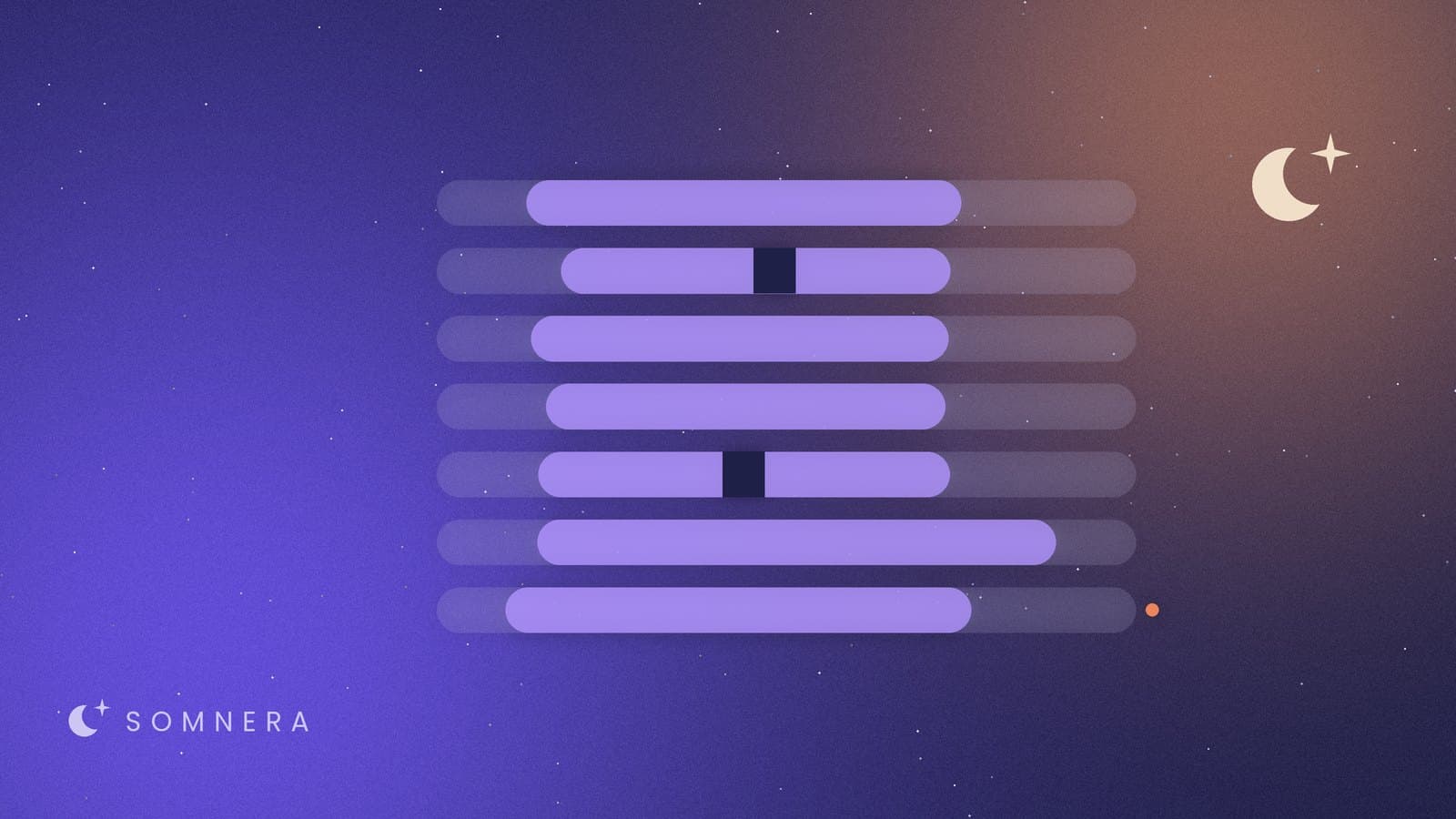
This is not a warning about a rare side effect. It is what the method does. Researchers who measured it directly during sleep restriction found increased daytime sleepiness and measurably worse vigilance during the early phase, which is exactly what you would predict from deliberately building sleep pressure.

It matters for two reasons. The first is practical: sleepiness affects driving and anything else that needs sustained attention, and that has to be planned around rather than pushed through. The second is that this is the moment people conclude it is not working and stop — usually somewhere in the first fortnight, right before the point where sleep starts consolidating.

Knowing it is coming is most of the defence against it.

When this is the wrong approach

Sleep restriction is studied in insomnia. It is not the answer to every kind of bad sleep, and there are situations where narrowing the window is a poor idea or where something else needs looking at first.

  • Loud snoring, gasping or choking awake, or someone telling you that you stop breathing — that points toward sleep apnoea and needs assessing on its own.
  • An irresistible urge to move your legs in the evening, eased by moving them.
  • Shift work, or a schedule that changes week to week.
  • Pregnancy.
  • A history of seizures or of bipolar disorder, where sleep loss carries specific risks.
  • Sleep that got worse suddenly rather than gradually, or that arrived alongside a new medication.

Any of those is a conversation with a clinician rather than a protocol to follow from a website.

Where it sits in CBT-I

Sleep restriction is not used alone. It runs alongside stimulus control — getting out of bed when you have been awake a while, keeping the bed for sleep — and alongside work on the thinking that keeps people awake, plus the scheduling that holds a rising time steady.

The reason any of this is worth the discomfort is that CBT-I is what clinical guidelines recommend before medication. The American College of Physicians has recommended it as the initial treatment for chronic insomnia in adults since 2016, and the American Academy of Sleep Medicine's behavioural treatment guideline reached the same position.

Somnera is a self-guided education program built around that approach. It is not a diagnosis and it does not replace care from your own clinician.

Citations

  • Spielman AJ, Saskin P, Thorpy MJ. Treatment of chronic insomnia by restriction of time in bed. Sleep. 1987;10(1):45–56.
  • Qaseem A, et al. Management of chronic insomnia disorder in adults: a clinical practice guideline from the American College of Physicians. Ann Intern Med. 2016;165(2):125–133. doi:10.7326/M15-2175
  • Trauer JM, et al. Cognitive behavioral therapy for chronic insomnia: a systematic review and meta-analysis. Ann Intern Med. 2015;163(3):191–204. doi:10.7326/M14-2841
  • Kyle SD, et al. Sleep restriction therapy for insomnia is associated with reduced objective total sleep time, increased daytime somnolence, and objectively impaired vigilance. Sleep. 2014;37(2):229–237. doi:10.5665/sleep.3386
  • Edinger JD, et al. Behavioral and psychological treatments for chronic insomnia disorder in adults: an American Academy of Sleep Medicine clinical practice guideline. J Clin Sleep Med. 2021;17(2):255–262. doi:10.5664/jcsm.8986

Frequently asked questions

Research on CBT-I generally runs the full approach over four to eight weeks. Many people notice their sleep becoming more solid somewhere in weeks two to four, after an initial period of feeling more tired.

No. Sleep deprivation means getting less sleep than your body needs. Sleep restriction narrows the window you spend in bed so that the sleep you are already getting becomes more consolidated. Total sleep often goes down at first and then recovers.

Compressing time in bed builds sleep pressure, and higher sleep pressure means more daytime sleepiness before sleep becomes more solid. Studies measuring this directly have found increased sleepiness and reduced vigilance during the early phase.

Standard protocols set a floor, usually around five hours, and do not go under it regardless of what the diary shows. Anyone considering a shorter window should be doing this with a clinician.

Napping releases the sleep pressure the method is deliberately building, which is why protocols ask you to avoid it during this phase. If you are too sleepy to drive or work safely, that is a reason to widen the window, not to nap.